
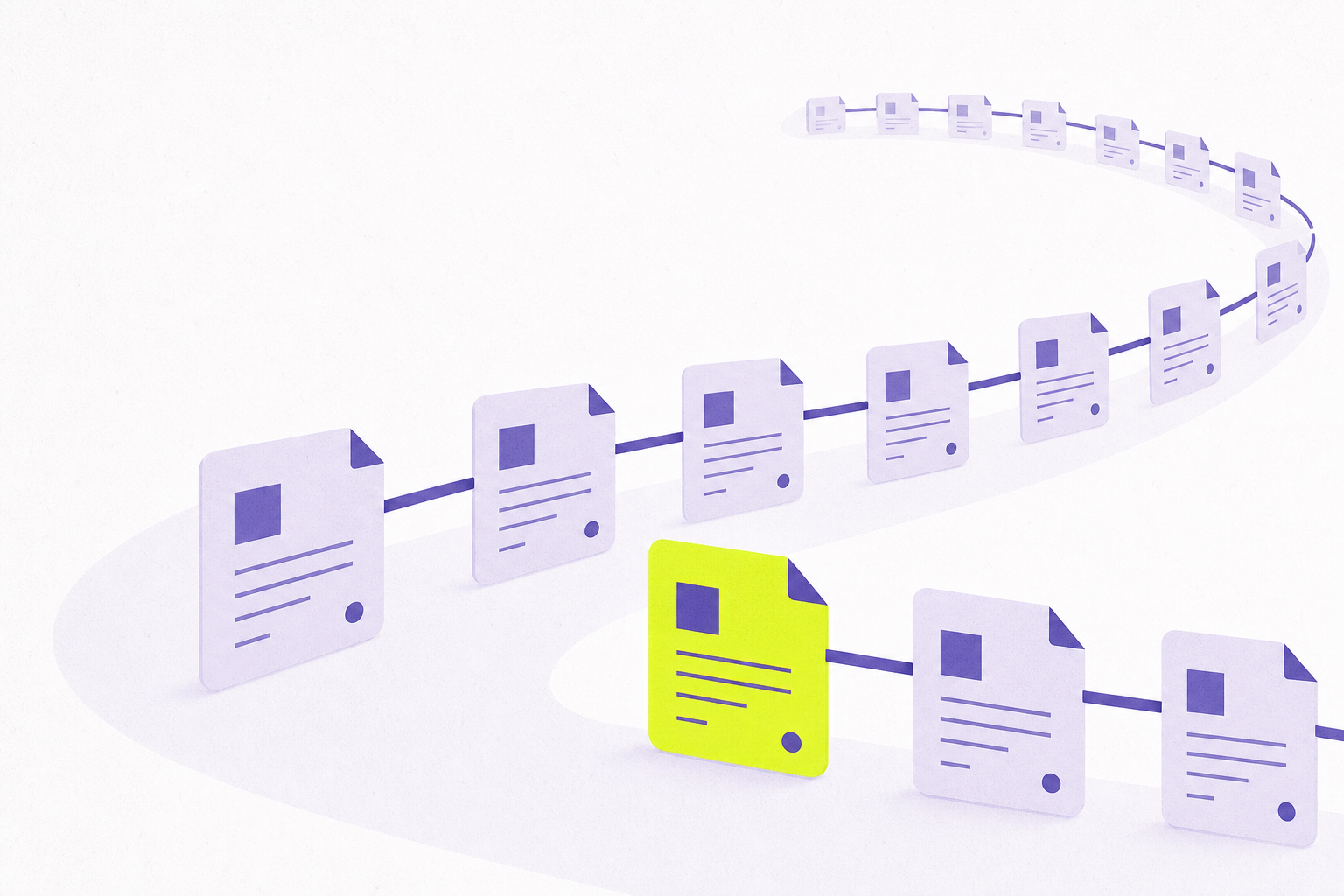
An audit-ready loan file answers three questions without a scramble: what was executed, who touched the file, and when. Examiners ask for the closed documents, the activity record behind them, and proof of who had access. Build that record during the closing and audit prep becomes an export, not a project.
What examiners actually ask for
Strip away the agency-specific vocabulary and every safety-and-soundness exam asks the loan file three questions. What was executed: the complete closed document set, matching the approval and the commitment. Who touched the file: the record of access, uploads, edits, and status changes. And when: timestamps that prove sequence, that the appraisal predated the approval, that the flood determination predated closing, that the review happened before the line closed.
Examiners sample rather than read everything, which is why consistency is the real standard. One immaculate file proves nothing if the next three are archaeology. The OCC's handbook language and NCUA's examination programs differ in wording, but the operational bar is the same: any sampled loan produces its documents and its history on request, in minutes, in the same shape every time.
Build the record during the closing, not after it
The expensive way to prepare for an exam is reconstruction: two weeks of pulling emails, chasing versions, and rebuilding who-did-what from memory. The cheap way is to let the closing write its own record. When every document lands against a checklist line, every status change is logged with its actor and timestamp, and every party works in the same room, the audit trail is a byproduct with zero marginal effort.
The practical test of your current system: pick a loan that closed eighteen months ago and try to answer, within ten minutes, who uploaded the final title policy, when the insurance certificate was accepted and by whom, and which version of the rent roll underwriting relied on. If any answer lives in an inbox, the record is the inbox, and the inbox leaves with its owner.
Prodeal has run commercial closings for ten years and 56,000 deals, with every action logged as it happens.
The access record is half the exam
File completeness answers what; the access record answers who could see it and who did. Party-scoped permissions, borrower, counsel, title, vendor, each seeing only its slice, are the control examiners and security reviewers probe first, and the log of actual access is the evidence that the control worked.
Two practices make this reviewable rather than theoretical. Keep permissions at folder and file level so scope is demonstrable line by line, and export the activity log, views, uploads, edits, status changes with actors and timestamps, as part of every closed-loan package. When the question is who had access to the borrower's financials, the answer should be a report, not a recollection.
The closing binder: the file's public face
The binder is the deliverable everyone eventually asks for: servicing to board the loan, participants to satisfy their own files, auditors and examiners to sample, counsel in any later dispute. A binder standard, the same fixed order and complete set on every deal, is what makes sampling painless, and a hyperlinked PDF with a clickable index is the difference between retrieval and spelunking.
Compile it at funding, not at exam time. The executed set is complete on funding day and entropy only degrades it afterward; a binder produced from the checklist at close is complete by construction, because the checklist was the definition of complete.
Your system is part of the exam
Examiners increasingly treat the systems holding loan records as vendors subject to third-party risk review. The questions are standard: where the records live, who can access them, what the provider's own controls look like, and whether the audit log can be produced independently of the provider's goodwill.
Have the provider's SOC report in the vendor file before anyone asks; Prodeal is SOC 2 audited annually and its Type II report is available to customers for exactly this purpose. And confirm the export path: records you cannot extract in usable form are records you do not fully control, which is itself an exam finding waiting to happen.
Questions lenders ask
- What is in a post-closing audit trail?
- Three layers: the complete executed document set, the activity record behind it (every view, upload, edit, and status change with actor and timestamp), and the access record showing who could see what. Together they answer what was executed, who touched the file, and when.
- What do examiners ask for from closed loan files?
- Sampled files that produce their documents and their history quickly and consistently: the closed set matching the approval, evidence of required sequence (appraisal before approval, flood determination before closing), and the record of access. Consistency across files matters more than any single perfect file.
- How long does exam prep take with a live audit trail?
- Approaching zero marginal time, because the record accumulates during the closing. Teams that reconstruct from email spend days per exam cycle; teams whose closing system logs every action export the record instead of rebuilding it.
- Should the activity log be exportable?
- Yes, and test it before an examiner asks. The log should export with actors and timestamps intact, independent of the vendor's involvement. Prodeal exports the activity record to XLSX or CSV, and its SOC 2 Type II report is available to customers for the vendor-review file.
- What is the fastest way to make old files audit-ready?
- Fix the go-forward first: run current closings in a system that writes the record as it happens, so every new file is born audit-ready. Backfilling old files is a judgment call by exam exposure; the compounding value is in the go-forward record.
Sources and further reading
- The commercial loan closing checklistThe list the record is built from.
- Glossary: closing binderThe deliverable examiners ask for first.
- Security at ProdealCertifications, encryption, and the immutable audit trail.
- Prodeal’s SOC 2 Type II report is available to customersWhat the report covers and how to get it.
- Prodeal vs DatasiteClosing platform against data room, honestly compared.