
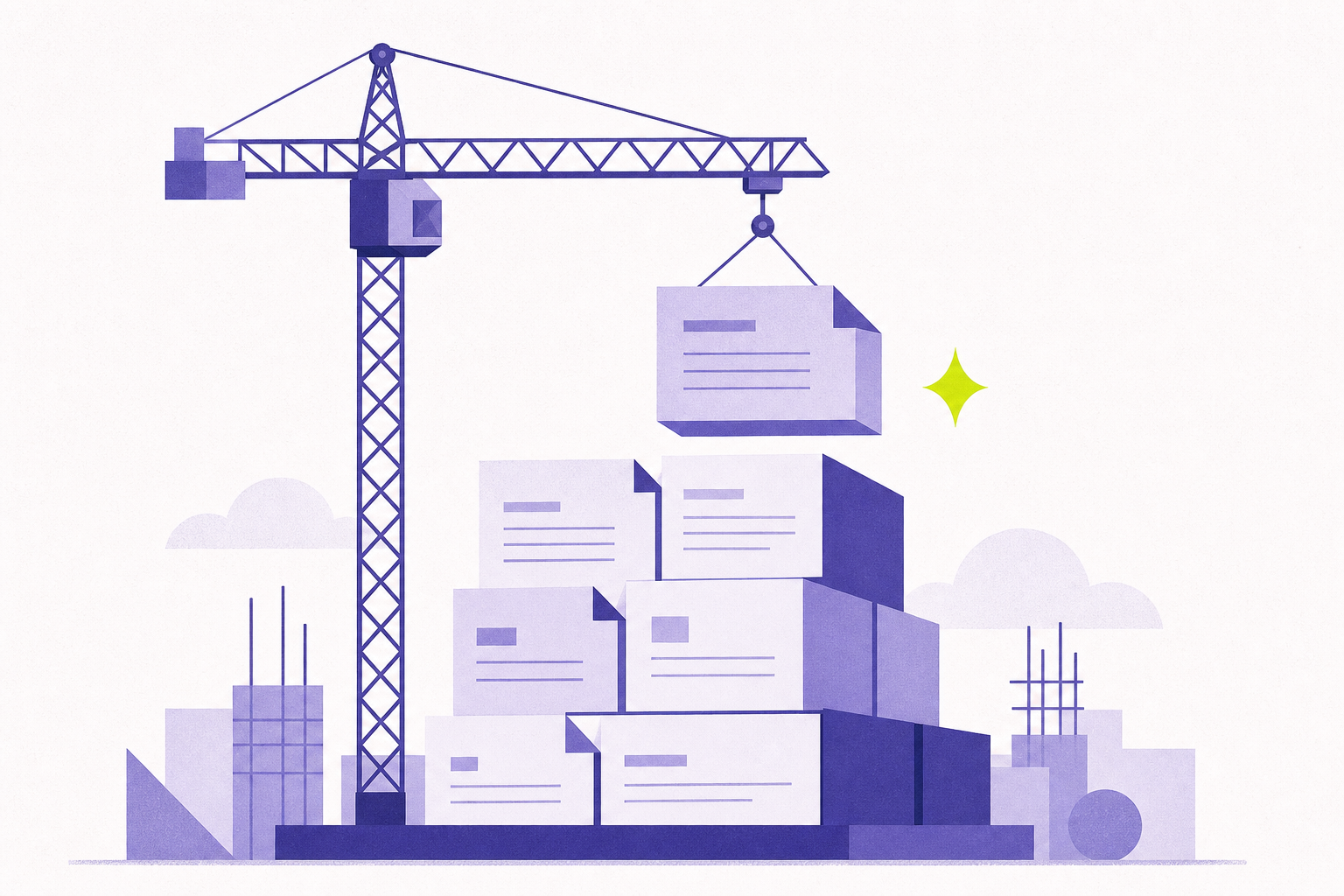
A construction loan closes twice: once at the initial closing, with everything a permanent loan needs plus budget, plans, contracts, and completion support, and then again every month, because each draw is a miniature closing with its own package. Teams that template both cycles stop treating draws as fire drills.
A construction loan closes twice
Every construction loan closes twice. Once at the initial closing, which requires everything a permanent loan needs plus an entire second checklist about a building that does not exist yet. And then again every month, because each draw is a miniature closing with its own conditions, its own documents, and its own approval.
That second closing, repeated twenty times over a construction period, is what makes construction lending an operations problem rather than a documentation problem. The initial close is finite and knowable. The draw cycle is a treadmill, and teams that run it on email discover that a twenty-month project generates twenty opportunities to lose a lien waiver.
What the initial close adds
On top of the standard commercial closing set, the initial construction close adds the project itself:
| Family | What it covers | Owner |
|---|---|---|
| Budget and sources | Line-item budget, sources and uses, contingency, borrower equity verification | Lender and borrower |
| Plans and specifications | Approved drawings and specs, the lender's plan-and-cost review | Borrower, third-party reviewer |
| Construction contract | The contract with the general contractor, commonly on an AIA form, plus the schedule of values | Borrower and GC |
| Contractor diligence | GC financials, references, license, and payment and performance bonds or an acceptable alternative | Lender |
| Permits and entitlements | Building permit, site work approvals, utility will-serve letters, zoning confirmation | Borrower |
| Completion support | Completion guaranty, and on many deals a carry guaranty | Guarantor and counsel |
| Construction-specific insurance | Builder's risk, GC and subcontractor coverage, and the wording the loan agreement requires | Borrower |
| Title with construction endorsements | Pending disbursement provisions and mechanic's lien coverage where available | Title company |
| Draw mechanics | The disbursement agreement, the draw request form, inspection protocol, and retainage terms | Lender and counsel |
The monthly draw: a closing with a due date
Once construction starts, the checklist becomes a recurring cycle. A typical draw requires the contractor's payment application against the schedule of values, commonly on the AIA G702 and G703 forms, lien waivers from the GC and every sub who has been paid, the inspector's or engineer's report confirming the work claimed is the work done, an updated title date-down endorsement covering the new advance, and evidence that the budget still balances after the draw.
Two things make this hard and neither is intellectual. First, the volume: dozens of parties, monthly, each contributing a document that blocks the money. Second, the sequence: a missing conditional waiver from one drywall sub stops a seven-figure disbursement, and everybody on the project learns about it on the day the money was supposed to move.
The operational fix is the same one that works on the initial close, applied on a monthly loop: one live list per draw, every required document as a line, an owner on each, dates that fire reminders, and a status every party can see without calling the loan admin. Run that way, a draw is a routine; run on email, it is a monthly fire drill.
Where construction files actually break
The recurring failures are boringly consistent across shops:
- Lien waiver gapsThe sub who was paid but whose waiver was never collected. Discovered at the next title date-down, or worse, at a lien filing.
- Budget drift without a documented reallocationLine items moved informally, so the file no longer matches the loan agreement's budget.
- Stale inspectionsA draw funded on a report that predates the work claimed.
- Retainage arithmeticRetainage held and released inconsistently across draws, reconciled only at the end when it is expensive to fix.
- Insurance lapse mid-projectBuilder's risk that expires in month fourteen because the renewal date lived in one person's calendar.
- Change orders outside the fileScope changed, budget did not, and the file's version of the project drifted from the site's.
Conversion and the file you leave behind
At completion the loan either pays off, converts to permanent, or gets sold, and each path tests the file the draws produced. Conversion conditions typically include the certificate of occupancy, final lien waivers, the as-built survey, final cost certification on some programs, and debt-service-coverage or occupancy hurdles proven from real operating data.
This is where the twenty-month treadmill either pays off or bills you. A file where every draw's documents, approvals, and inspections sit against their lines converts on a read-through. A file assembled from twenty months of inboxes gets reconstructed, at exactly the moment the borrower expects speed. On HUD-insured construction under 221(d)(4), the same logic runs with far more prescribed exhibits, which is why those teams template the whole cycle rather than improvise it.
Questions lenders ask
- What is on a construction loan closing checklist?
- Everything a permanent loan needs, plus the project: line-item budget and sources and uses, approved plans and specs with a plan-and-cost review, the construction contract and schedule of values, contractor diligence and bonding, permits and entitlements, completion and carry guaranties, builder's risk insurance, title with construction endorsements, and the draw and disbursement mechanics.
- What documents does a construction draw require?
- Commonly the contractor's payment application against the schedule of values (often AIA G702 and G703), lien waivers from the GC and every paid subcontractor, an inspection or engineer's report confirming the work, a title date-down endorsement for the new advance, and evidence the budget still balances.
- Why are construction loans harder to administer than permanent loans?
- Because they close every month. Each draw is a miniature closing with its own conditions, documents, and approvals, across dozens of parties, for the length of the project. A twenty-month build is twenty chances to lose a lien waiver and stop a disbursement.
- What breaks construction loan files most often?
- Lien waiver gaps, undocumented budget reallocations, inspections that predate the work claimed, inconsistent retainage math, builder's risk lapsing mid-project, and change orders that never reached the file. All are tracking failures rather than credit failures.
- What is required at conversion to permanent?
- Typically the certificate of occupancy, final lien waivers, the as-built survey, final cost certification on some programs, and performance hurdles like debt service coverage or occupancy proven from real operating data. A file where every draw was tracked converts on a read-through; one assembled from inboxes gets reconstructed.